
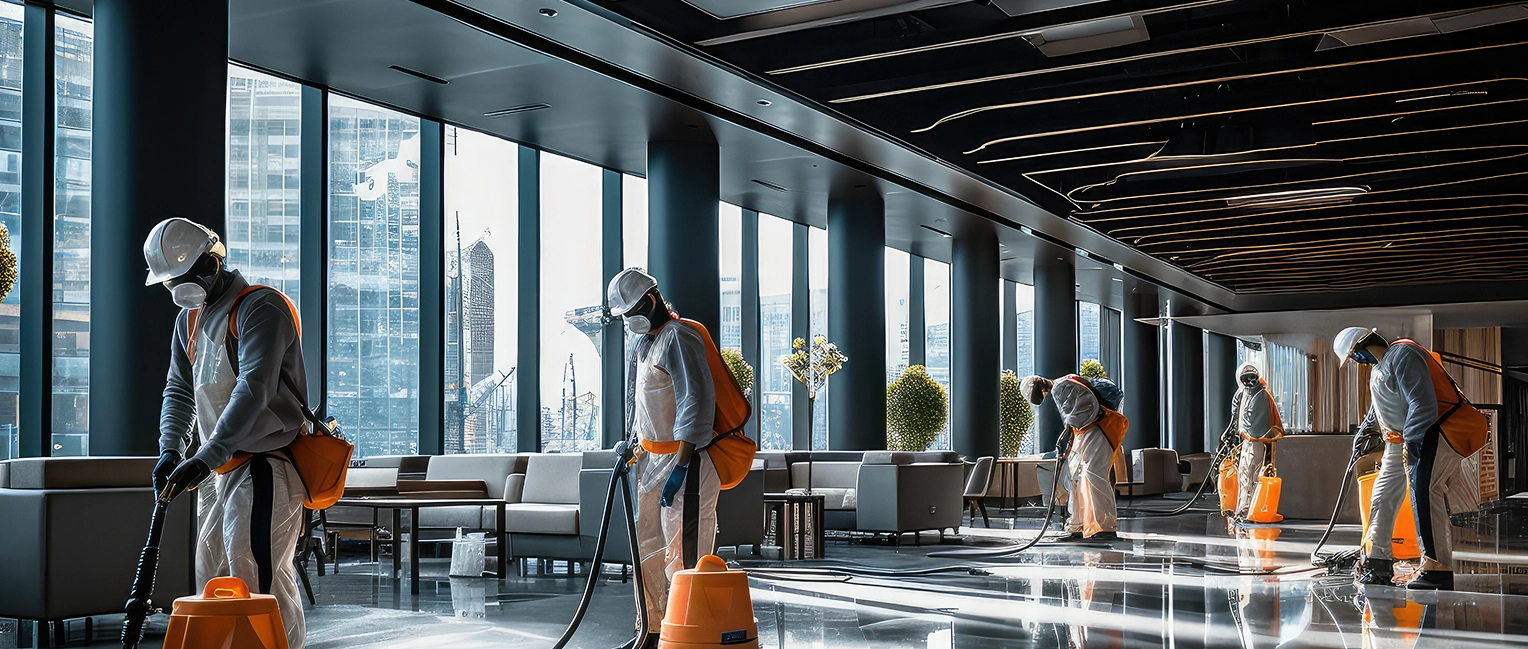
What Are Commercial Facility Services?
Commercial facility services are the ongoing services that keep a commercial property clean, functional, safe, secure, and ready for daily use.
For most facilities, that means coordinating several service areas at once; not just calling someone when something breaks or scheduling cleaning after hours. A well-managed facility services plan may include routine janitorial work, technical maintenance, building repairs, security coverage, access control, safety support, pest prevention, and compliance-related documentation.
In simple terms, commercial facility services help answer questions like:
- Who keeps the building clean and stocked?
- Who handles recurring maintenance and repairs?
- Who monitors security risks after hours?
- Who checks safety items like exits, signage, and emergency equipment?
- Who responds when something needs attention quickly?
- Who keeps service records organized?
For busy facility and operations teams, the value is coordination. Instead of managing each service separately, a facility services provider can help organize the day-to-day work needed to keep the property running smoothly.
Common areas included in commercial facility services
| Service Area | What It Usually Covers |
|---|---|
| Facility Cleaning | Janitorial services, restroom cleaning, floor care, deep cleaning, disinfection, post-construction cleanup |
| Technical Maintenance | HVAC support, plumbing, lighting, repairs, inspections, handyman work, exterior maintenance |
| Health, Safety & Compliance | OSHA/EPA-related cleaning, fire watch, egress checks, safety signage, incident reporting, pest control |
Commercial facility services can be handled in-house, outsourced to multiple vendors, or managed through one coordinated provider. The right approach depends on the size of the facility, foot traffic, risk level, operating hours, and how much internal bandwidth the team has.
Why Commercial Facility Services Matter
Commercial facility services matter most when they are handled consistently, efficiently, and with clear accountability.
- Operational continuity: Reliable cleaning, maintenance, security, and safety support help keep the building running without unnecessary disruptions.
- Risk reduction: Preventive maintenance, safety checks, sanitation, and security procedures can help reduce avoidable issues before they become urgent problems.
- Vendor coordination: A coordinated facility services plan gives managers fewer moving parts to chase and clearer visibility into who is responsible for what.
The result is a cleaner, safer, more predictable facility with less day-to-day friction for the management team.
What Services Are Usually Included in Commercial Building Maintenance?
Commercial facility services usually fall into 4 main categories:
- Facility cleaning
- Technical maintenance
- Security and surveillance
- Health, safety, and compliance
The exact mix depends on the type of facility, how often the building is used, how much foot traffic it gets, and whether the property has any industry-specific requirements. For example, an office building may need daily janitorial service and occasional repairs, while a healthcare facility may need more detailed cleaning, waste handling, and compliance support.
The goal is not to use every service available. The goal is to build the right service mix for the facility.
| Service Category | Examples of included services | Why it matters |
|---|---|---|
| Facility Cleaning | Janitorial services, restroom and breakroom cleaning, floor care, disinfection, industrial cleaning, post-construction cleanup, exterior cleaning, day porter support. | Keeps the facility clean, sanitary, presentable, and ready for employees, tenants, customers, and visitors. |
| Technical Maintenance | HVAC, plumbing, lighting, repairs, preventive inspections, handyman services, exterior maintenance, groundskeeping. | Helps keep building systems operational and reduces the chance of small issues becoming larger repairs. |
| Security & Surveillance | On-site guards, mobile patrols, access control, CCTV, alarm response, checkpoint management, parking lot and perimeter security. | Helps protect the property, control access, monitor activity, and support a safer environment. |
| Health, Safety & Compliance | OSHA/EPA-related cleaning, fire safety checks, egress clearance, safety signage, emergency planning, incident reporting, pest control, medical waste support. | Helps facilities stay safer, better prepared, and more organized around documentation, inspections, and risk-related responsibilities. |
Facility Cleaning Services
Facility cleaning covers the routine and specialized tasks that keep commercial spaces clean, sanitary, and presentable.
This can include janitorial services, restroom and breakroom cleaning, trash and recycling disposal, floor care, carpet care, high-touchpoint disinfection, industrial cleaning, cleanroom cleaning, post-construction cleanup, move-in and move-out cleaning, exterior window washing, pressure washing, day porter support, and event setup or teardown cleaning.
For facilities with high traffic, customer-facing areas, or stricter hygiene needs, cleaning should be planned by area, frequency, and risk level rather than handled as a generic checklist.
Technical Maintenance Services
Technical maintenance covers the recurring inspections, repairs, and building system support needed to keep a commercial facility operating properly.
This can include HVAC inspections, air filter replacement, duct and ventilation cleaning, lighting maintenance, emergency light testing, plumbing repairs, leak detection, drain maintenance, preventive inspections, on-demand repairs, door and lock adjustments, ceiling tile replacement, paint touch-ups, minor carpentry, handyman services, gutter cleaning, roof drain inspections, and groundskeeping.
For facility teams, the goal is to catch small issues early, reduce downtime, and keep building systems working without constant disruption.
Security & Surveillance Services
Security and surveillance services help protect the property, control access, monitor activity, and support a safer environment for employees, tenants, visitors, and assets.
This can include on-site security guards, mobile patrols, checkpoint management, after-hours lockup, alarm response, front desk or reception security, security escorts, access control systems, badge and credential management, CCTV installation, live video monitoring, remote surveillance, motion detection, intrusion alarms, gate guard services, vehicle access management, loading dock supervision, parking lot surveillance, and perimeter security.
Some facilities need visible on-site coverage. Others may need access control, cameras, after-hours patrols, or a mix of several solutions. The right setup depends on the facility layout, operating hours, visitor flow, risk level, and security concerns.
Health, Safety & Compliance Services
Health, safety, and compliance services help facilities stay organized around risk-related responsibilities, safety readiness, documentation, and specialized cleaning or environmental needs.
This can include OSHA/EPA-related cleaning, fire extinguisher checks, emergency egress and path clearance, safety signage installation, first-aid station cleaning, sharps and medical waste disposal, fire watch services, evacuation drills, emergency response planning, incident reporting, pest prevention, rodent control, insect control, bird deterrent systems, and certified safe pesticide use.
This category is especially important for facilities with higher risk, public access, regulated environments, or recurring safety documentation needs.
Related Resources
One Vendor vs. Multiple Vendors
Many commercial facilities rely on separate vendors for cleaning, repairs, security, pest control, and compliance-related services. That can work, especially when each vendor has a narrow specialty.
The challenge is coordination.
More vendors usually means more schedules, more invoices, more points of contact, and more follow-up. When responsibilities are unclear, facility managers can end up spending too much time chasing updates or solving communication gaps.
A single coordinated provider can simplify the process by giving the facility team one main point of contact, clearer expectations, and better visibility across services.
| Approach | Pros | Challenges |
|---|---|---|
| Multiple Vendors | Specialized providers; flexibility to choose different vendors for different needs. | More coordination, more communication gaps, more invoices, and less centralized accountability. |
| One Coordinated Provider | Easier scheduling, clearer ownership, fewer points of contact, and more consistent service planning. | Requires choosing a provider with enough service coverage and operational capacity. |
The best option depends on the facility. For smaller or simpler properties, separate vendors may be manageable.
For larger, busier, or multi-service facilities, a coordinated model can reduce friction.
Related Resources
When to Outsource Facility Services
Outsourcing facility services can make sense when the internal team no longer has the time, staff, or specialized support to manage everything consistently.
Common signs include:
- Cleaning quality is inconsistent
- Maintenance issues are becoming reactive
- Small repairs are taking too long to address
- Security needs are increasing
- Compliance documentation is difficult to manage
- The facility has high traffic or extended operating hours
- The team is managing too many vendors
- Multiple locations need more consistent service standards
- Internal staff is spending too much time on coordination
Outsourcing does not always mean handing off every service. It can also mean bringing in support for the areas that are most time-consuming, specialized, or difficult to manage internally.
How to Choose a Commercial Facility Services Provider
Outsourcing facility services can make sense when the internal team no longer has the time, staff, or specialized support to manage everything consistently.
When comparing providers, consider:
- Service range: Can they support cleaning, maintenance, security, and compliance-related needs?
- Commercial experience: Do they understand commercial buildings, high-traffic spaces, regulated environments, or multi-site operations?
- Customization: Can they build a plan around the facility’s schedule, risk level, and priorities?
- Response process: How are urgent issues handled?
- Communication: Who is the main point of contact?
- Documentation: Can they provide service logs, incident reports, or other records when needed?
- Staffing and supervision: How are teams trained, managed, and held accountable?
- Scalability: Can they support additional services or locations as needs change?
The goal is to choose a provider that can deliver consistently, communicate clearly, and reduce the operational burden on the facility team.
Facility Services by Facility Type
vDifferent facilities need different service mixes. The right plan for an office building may look very different from the right plan for a warehouse, healthcare facility, school, or construction site.
| Facility Type | Common Facility Service Needs |
|---|---|
| Offices & Corporate Buildings | Janitorial services, restroom and breakroom cleaning, lighting maintenance, access control, day porter support, visitor-facing upkeep. |
| Healthcare & Medical Facilities | Detailed cleaning, high-touch disinfection, medical waste support, safety documentation, pest prevention, compliance-related services. |
| Warehouses & Industrial Facilities | Industrial cleaning, equipment-area cleaning, floor care, lighting maintenance, loading dock supervision, pest control, security. |
| Schools & Campuses | Daily cleaning, cafeteria and restroom cleaning, groundskeeping, access control, safety signage, evacuation planning, incident reporting. |
| Construction Sites | Post-construction cleanup, move-in readiness, mobile patrols, surveillance, gate guard services, final handoff support. |
| Government & Public Facilities | Cleaning consistency, safety documentation, access control, public-facing maintenance, emergency preparedness, vendor reliability. |
The more complex the facility, the more important it becomes to coordinate services around how the building is actually used.
What to Include in a Facility Services Plan
A facility services plan should define what needs to happen, how often it should happen, who is responsible, and how issues should be reported or escalated.
At a minimum, the plan should account for:
- Facility type and square footage
- Number of buildings or locations
- Operating hours
- Foot traffic level
- Cleaning frequency
- High-priority areas
- Maintenance schedule
- HVAC, plumbing, electrical, and repair needs
- Security coverage
- Access control requirements
- Safety and compliance responsibilities
- Pest control needs
- Exterior maintenance needs
- Emergency response process
- Reporting and documentation expectations
- Main point of contact
- Escalation process
- Review schedule
The plan does not need to be complicated. It just needs to be clear enough that both the facility team and the service provider understand what is expected.
Final Thoughts
Commercial facility services are not just about keeping a building clean or fixing problems when they happen. They are about creating a more organized, reliable system for managing the day-to-day needs of a commercial property.
For facility, operations, and property managers, the right service plan can reduce vendor complexity, improve accountability, and make the building easier to manage.
Whether the facility needs cleaning, maintenance, security, compliance support, or a mix of all four, the best approach starts with understanding the building’s needs and building a service plan around them.
Need help building the right service mix for your facility? Contact Facility Experts to create a custom facility services plan.